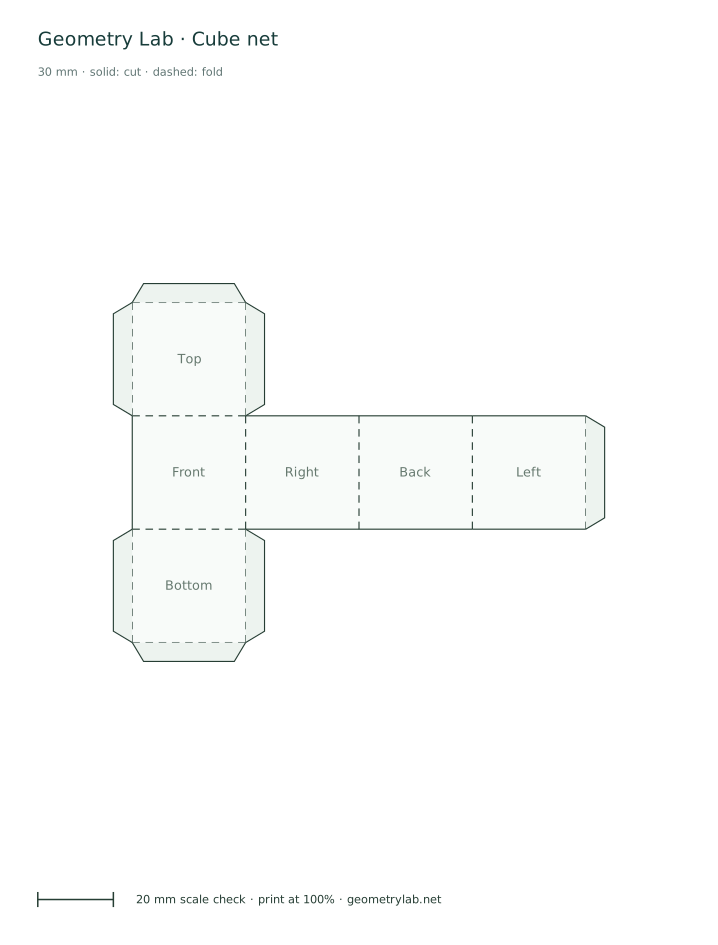
Cube net
6 faces · 12 edges · 8 vertices. Six equal squares in a cross. Fold them up into a box with all edges equal.
 geometrylabA PLACE FOR THINGS TO CLICK.Worksheets
Choose a cube, rectangular prism, or square pyramid net, set its size in millimeters, then print, cut, and fold. Every net has dashed fold lines, labeled faces, and optional glue tabs.
6 faces · 12 edges · 8 vertices. Six equal squares in a cross. Fold them up into a box with all edges equal.
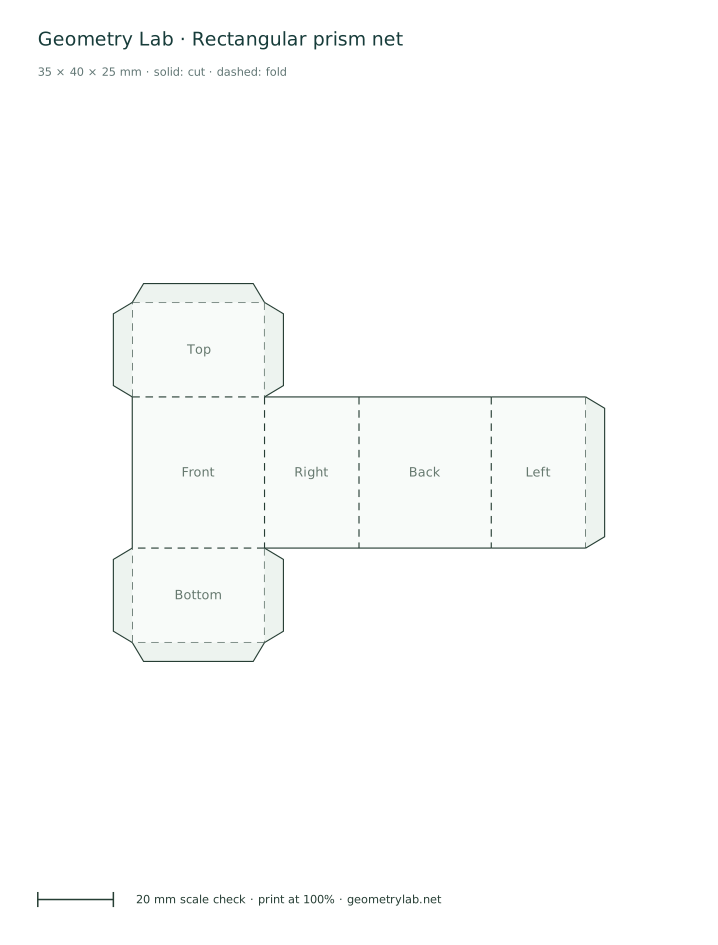
6 faces · 12 edges · 8 vertices. Six rectangles in three matching pairs. Choose any width, height, and depth that fits the page.
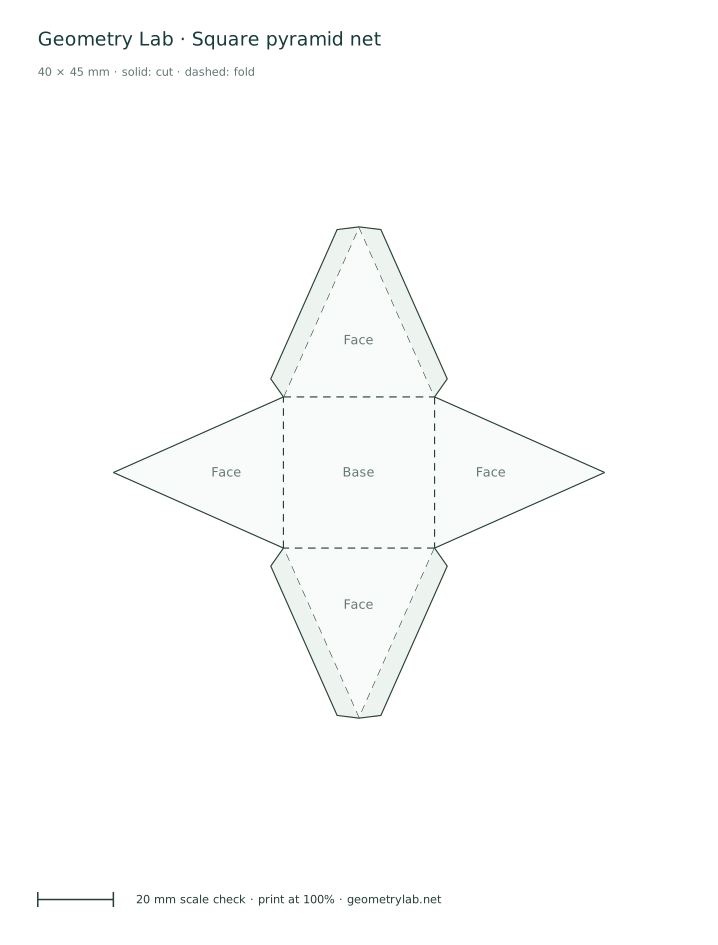
5 faces · 8 edges · 5 vertices. A square base with four triangular faces. Slant height is the height of each triangle, not of the pyramid.
Print on A4 at 100% scale. Turn off browser headers and footers. The 20 mm reference line lets you check the printed size.
For the pyramid, “slant height” is the altitude of a triangular face. It must be greater than half the base width to create a non-flat pyramid.
Wondering about the why? Start here.
Print on A4 paper at 100% scale (not “fit to page”) and turn off browser headers and footers. Measure the 20 mm reference line at the bottom of the page; if it is 20 mm, every edge is printed to the size you chose.
A square base with four triangles attached to its sides. Each triangle’s height is the pyramid’s slant height, which must be more than half the base width so the faces can meet at a point.
Pyramid volume and surface areaA cube has 11 different nets, not counting rotations and reflections. This generator uses the familiar cross-shaped net: four faces in a row with one face above and one below.
Tabs go on outside edges that must join another face. A cube or rectangular prism net needs seven glued seams to close; a square pyramid needs four. Fold every dashed line inward before gluing.